About Us
Manila Bay Clean-up, Rehabilitation, and Preservation Program

The DILG, through its mandate of general supervision over local government units (LGUs) gives primacy to develop and scale up the capacity of LGUs to become environment-protective, climate change adaptive, and disaster resilient. For the promotion of public interest, the rights of every Filipino citizen to a balanced and healthful ecology under the constitution, and the DILG’s continued compliance to the mandate to clean-up, rehabilitate and preserve the Manila Bay, the Manila Bay Clean-up, Rehabilitation, and Preservation Program is created. The MBCRPP Program Management Office (PMO) shall be the office responsible in complying with the directives for the DILG under the SC Continuing Mandamus. It is currently lodged under the Bureau of Local Government Supervision (BLGS), and directly supervised by the Office of the Assistant Secretary for Special Concerns- Local Government Sector (OASSC-LGS) by virtue of Department Order No. 2020-597.
The Program shall always trace its wisdom and basis on the SC continuing mandamus, the responsibilities of the Department as stated in the jurisprudence, existing laws and policies in support of the program, and the LGUs Outcome Areas stated in the Operational Plan for the Manila Bay Coastal Strategy (OPMBCS), and the Manila Bay Sustainable Development Master Plan (MBSDMP).
Directly reporting to the MBCRPP-PMO are the MBCRPP- Program Management Teams (PMTs) of Regions III, IV-A, and the NCR, under the supervision of the respective Regional Offices, which have their own assigned Focal Persons and Program Officers, who cater to the implementation of the Manila Bay Program in their respective areas. The MBCRPP-PMTs directly coordinate with the LGUs to provide them with the necessary assistance in order to perform actions and duties that will service the attainment of the targets and goals of the MBCRPP.
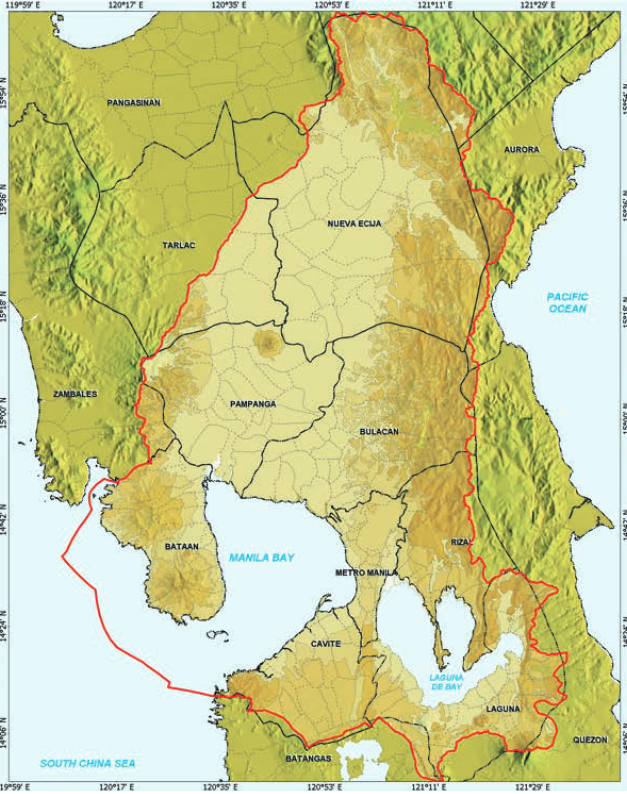
Manila Bay Area
- Region III (94 LGUs)
- Nueva Ecija
- Tarlac
- Pampanga
- Bulacan
- Bataan
- Region IV-A (76 LGUs)
- Rizal
- Cavite
- Laguna
- Batangas
- National Capital Region (17 LGUs)
187 Local Government Units

Program Thrust
Manila Bay Clean-up, Rehabilitation, and Preservation Program
Monitoring LGU Compliance Data
Compliance data of each LGU is submitted to the MBCRPP, on a quarterly basis, to regularly keep track of the progress in the implementation of the Program. Audit tools are created to assess the performance of LGUs when it comes to fulfilling their mandates under environmental laws and policies.
Audit LGU Performance
The Local Government Units Compliance Assessment serves as a mechanism in monitoring the compliance of LGUs within the Manila Bay watershed area with regard to their adherence to the SC continuing Mandamus. The assessment aims to increase the enforcement of the program, and to effectively keep track the LGUs’ compliance to the environmental laws that support the rehabilitation of Manila Bay. LGUs whose overall score ranks lowest may be endorsed to the Office of the Ombudsman for possible filing of complaints.
The Manila BAYani Awards and Incentives (MBAI) is an initiative of the DILG to grant cash incentives to LGUs that have shown exemplary performance in meeting specific indicators if the Program. It was introduced in 2014, as part of the Environmental Compliance Audit (ECA), a tool focused on the assessment of LGUs’ performance and compliance to R.A. No. 9003, or the Ecological Solid Waste Management Act of 2000. Starting 2019, the scope of the MBAI was expanded to cover the outcome areas under the LGU Compliance Assessment, namely: Liquid Waste Management, Solid Waste Management, Management of ISFs, and IEC and Institutional Arrangement (IA).
Monitoring of LGUs’ Compliance through the Fisheries Compliance Audit: The Fisheries Compliance Audit was created by this Department to monitor compliance of LGUs to R.A. No. 8550 or the Philippine Fisheries Code of 1998, as amended by R.A. No. 10654. The audit tool was drafted together with partner agencies and non-government organizations (NGOs). The tool us utilized by the thirty-four (34) coastal LGUs in the Manila Bay Region.
Capacity Development Intervention
Capacity Building activities are continuously provided to enhance and develop the knowledge and skills of LGUs personnel which will allow them to better perform their roles and mandates under environmental laws. The capacity building activities serve to support the institutional mechanism of LGUs, to be able to successfully implement their programs, projects, and activities (PPAs), and efficiently deliver outputs that will meet that targets and objectives of the Manila Bay rehabilitation program.
Policy Formulation
The MBCRPP issues policies, through Memorandum Circulars, Memorandum, and Advisories, to provide LGUs with further guidelines to support the implementation of their PPAs and mandates. The policies may serve to lay down rules and regulations or clarify or expound on specific information that can guide LGUs in identifying strategies and creating well-informed decisions.
Outcome Areas
Manila Bay Clean-up, Rehabilitation, and Preservation Program

Outcome Area I
Liquid Waste Management and Reduction of Pollution Load
The Compliance of LGUs on the inspection of commercial establishments (CEs), factories (Fs), and private homes (PHs), on having adequate wastewater treatment facilities and septic tanks are constantly being monitored by the MBCRPP-PMT, with focus on LGUs with low compliance. Wastewater treatment facilities of commercial establishments and factories must pass in terms of design standards and functionality as determined by national laws and policies, to be considered compliant. Private Homes are inspected in terms of having septic tanks that are in compliance with the design standards set by the IRR of Presidential Decree (P.D) No. 856 or the Sanitation Code of the Philippines. Pursuant to R.A. No. 9275 or the Philippine Clean Water Act of 2004, R.A. No. 7160 or the Local Government Code of 1991, Presidential Decree No. 856: Code of Sanitation of the Philippines, the OPMBCS and the MBSDMP, the LGUs are expected to fulfill the following duties and responsibilities:
- Inspect and monitor commercial establishments and factories, with regard to the presence or absence of wastewater treatment facilities or septage treatment plants, and private homes with regard to the existence of septic tanks. For permits, LGUs shall ensure that CEs and Fs have the necessary Environmental Compliance Certificate (ECC) and discharge permit;
- Develop and maintain a data inventory of the compliance of commercial establishments, private homes, and factories with regard to the presence or absence of septic tanks or sewerage treatment facilities and desludging. These data inventories must be updated on a regular basis;
- Stop direct discharge of untreated sewage to coastal waters and rivers from informal structures;
- Ensure strict compliance of General Effluent Standards Requirements in the issuance and renewal of Business Permits;
- Issue Notices of Violation (NOVs) for non-compliant CEs, Fs, and PHs, and regularly update the data inventories to reflect changes in terms of structures that have already complied;
- Monitor and regularly update the inventory of private homes not connected to any water concessionaire, on their compliance to sanitation, and availing of sanitation services (desludging) every five (5) years, or as the need arises;
- Identify available land and right of way for the construction of sewerage and septage treatment facility;
- Create and implement ordinances relevant to sanitation (Septage and Sewerage Management Ordinance
- Participate in Water Quality Management Area (WQMA) Activities, and Board Meetings; and
- Regulate and ensure that only accredited service providers may be allowed to engage in process of collection, treatment, and disposal of sewerage within their respective jurisdiction.
Outcome Area II
Solid Waste ending up in Manila Bay reduced
The pollution brought about by improper wastes management is a contributor to the continuous degradation of coastal areas waterways and that lead to the Manila Bay. The wastes and marine debris can impair ecosystems and habitats, deteriorate aesthetics, and pose public health risks not just to humans, but to marine species as well. It aggravates the flooding problems especially during the rainy seasons, due to the clogging of pumping stations and drainages.
LGUs’ performance and compliance to their mandates on proper solid waste management is monitored by the MBCRPP as part of the holistic approach in improving environmental management strategies for the rehabilitation of Manila Bay. Through proper waste management, the Department hopes marine debris and solid wastes that end-up in the bay is reduced. Pursuant to R.A. No. 9003 or the “Ecological Solid Waste Management Act of 2000”, R.A. No. 7160, and the OPMBCS, the LGUs are expected to fulfill the following duties and responsibilities:
- Formulate and implement the 10-Year Solid Waste Management Plan (SWMP);
- Create the City/ Municipal Solid Waste Management Committee/ Board (SWMB) where members of such is stated under Section 12 of R.A. No. 9003;
- Enjoin the creation of Barangay Ecological Solid Waste Management Committees (BESWMC) and monitor functionality of the Committees;
- Further capacitate and strengthen the BESWMC to become fully organized and functional;
- Ensure that all households are serviced by waste haulers that implement a scheduled segregation collection system;
- Implement and monitor mandatory segregation of wastes at source;
- Dispose Residual Wastes in a Sanitary Landfill (SLF) or approved disposal facility, through construction of own SLF or entering into Memorandum of Agreement (MOA) with an LGU with SLF, or a private service provider. LGU’s Residual Containment Area (if applicable) must adhere to the standards of the National Solid Waste Management Commission (NSWMC);
- Create and implement ordinances relevant to sanitation (Septage and Sewerage Management Ordinance
- Participate in Water Quality Management Area (WQMA) Activities, and Board Meetings; and
- Regulate and ensure that only accredited service providers may be allowed to engage in process of collection, treatment, and disposal of sewerage within their respective jurisdiction.
- Establish and maintain a functional City/Municipal Materials Recovery Facility (MRF), and ensure that all barangays have functional MRFs or Materials Recovery Systems (MRS);
- Formulate and maintain a data inventory of existing junk shops (include those which the barangays have a MOA with, as part of their alternative materials recovery systems);
- Ensure the closure and rehabilitation of open and controlled dumpsites;
- Conduct of Waste Diversion Activities in accordance to the LGUs’ 10-Year SWM Plan;
- Establish or adopt, and implement solid waste management ordinances;
- Establish an institutional set-up for Solid Waste Management through the Municipal/ City Environment and Natural Resources Office (M/CENRO);
- Conduct and document the weekly or monthly clean-up activities, and ensure timely submission of accomplished reporting template; and
- Ensure proper management, treatment, and disposal of healthcare wastes.
Outcome Area III
Management of Informal Settler Families and Reduction of Exposure to Flooding
Informal dwellers, as defined by the Philippine Statistics Office (PSA) are ‘one who settles on the land of another without title or right, or without the owner’s consent, whether in urban or rural areas’. Article 51 of the Water Code of the Philippines states easement areas and salvage zones are subject to public use, and no person shall be allowed to stay in these zones, or build structures of any kind.
Houses, structures, and other encroachments along the easement areas of waterways and other danger zones shall be permanently removed, to ensure the safety of informal settler families (ISFs), and to provide access to decent and affordable housing.
Upgrading the status of ISFs should not only address the unavailability of affordable housing options and limited access to waste management facilities, but should also ensure equitable share of economic growth, improve the overall well-being, and secure the safety of people from effects of climate change and natural disasters.
Pursuant to R.A. No. 7279 or the Urban Development and Housing Act of 1992, R.A. No. 10121 or the Philippine Disaster Risk Reduction and Management Act of 2010, R.A. No. 7160, and the OPMBCS and the MBSDMP, LGUs are expected to fulfill the following duties and responsibilities:
- Prevent the proliferation of ISFs within their territorial jurisdiction;
- Establish a Local Housing Governing Body/ Board through Sanggunian Resolution or Ordinance prescribing its specific functions and responsibilities;
- Ensure regular conduct of meetings of the LHB;
- Develop and regularly update the data inventory of ISFs along waterways and tributaries;
- Formulate and implement a Local Shelter Plan (LSP);
- Formulate and implement the Relocation and Resettlement Action Plan (RRAP) (if applicable);
- Develop Socialized Housing Projects for ISFs along waterways and tributaries;
- Implement programs, projects, and activities in relation to providing ISFs access to decent and affordable housing, or conduct activities geared towards decongestion or decentralization of ISF population;
- Clear or dismantle structures, constructions, and other encroachments established or built in violation of R.A. No. 7279;
- Update the Registry of Barangay Inhabitants to include informal settlements and inhabitants, and its location
- Prevent the proliferation of Professional Squatters and Squatting Syndicates through regular inspection, creation of Local Council Against Squatting Syndicates and Professional Squatters, and imposition of penalties, and institution of criminal cases;
- Maintain cleared, unoccupied areas, and recovered easements through the enactment of an ordinance, declare danger areas as no-build zones,
- Integrate disaster risk reduction measures into the local Comprehensive Development Plan (CDP) and Comprehensive Land Use Plan (CLUP); and
- Formulate and implement their Disaster Risk Reduction Management Plan (DRRMP) and Local Climate Change Adaptation Plan (LCCAP).
- Establish or adopt, and implement solid waste management ordinances;
- Establish an institutional set-up for Solid Waste Management through the Municipal/ City Environment and Natural Resources Office (M/CENRO);
- Conduct and document the weekly or monthly clean-up activities, and ensure timely submission of accomplished reporting template; and
- Ensure proper management, treatment, and disposal of healthcare wastes.
Outcome Area IV
Biodiversity Conservation, Fisheries Resource Management, and Sustainable Tourism
Unabated pollution leads to serious threats to the ecosystems and species in the Manila Bay. Ecosystem and biodiversity conservation, together with the improvement of water quality, are viewed to have strong linkage for the successful rehabilitation of the Bay. The marine species and ecosystems are drivers of economic growth and ontribute to the reduction of exposure to disasters and vulnerability to impacts of climate change.
Pursuant to Republic Act No. 8550 or the “Philippine Fisheries Code of 1998”, as amended by R.A. No. 10654, and R.A. No. 7160, and the OPMBCS and the MBSDMP, the LGUs are expected to fulfill the following duties and responsibilities:
- Regulate and monitor fishery activities, and strictly enforcement and implement fisheries rules and regulations in Municipal Waters;
- Formulate and implement Community-based Fisheries and Coastal Resource Management Plan, or mainstream such in the local development plans (CLUP and CDP);
- Draft, enact/ adopt, and/ or implement a Basic Municipal Fisheries Ordinance;
- Formulate Tourism Development Plans; and
- Create or activate their Fisheries and Aquatic Resources Management Council at the City/Municipal, and Barangay levels.
Outcome Area V
Implementation of MBCRPP
The information, education, and communication (IEC) activities, conduct of compliance assessments, institutialization of a rewards system, data and reports submission, and other technical assistance provided to the LGUs related to the Manila Bay rehabilitation program, are all geared towards ensuring that the objectives of the MBCRPP are achieved.